




Photo: Rivaz and the Lavaux vineyards above Lake Geneva, by Lorenz Poffet, via Wikimedia Commons, CC BY-SA 4.0.
Wednesday afternoons, late pick-ups, a call with another time zone: how au pair rules differ between Geneva, Vaud and neighbouring France, and what that means for your family.
If you are raising children around Lake Geneva, you know the shape of the problem. Primary school ends mid-afternoon, Wednesday afternoon is free, after-school care (the GIAP in Geneva, the APEMS or UAPE in Vaud) runs to fixed hours, and one of you has a call with another time zone at 5 p.m. For many families in the Know-it-all community, a live-in au pair is a flexible answer to those gaps. The catch is that the rules change with the border. Whether you live in Geneva, Nyon or Lausanne, or across the line in Ferney-Voltaire, Gex, Saint-Julien or Annemasse, the same arrangement follows a different legal framework. Here is what each one says.
Switzerland: the au pair as a worker
In Geneva, adult au pairs (aged 18 to 30) are covered by a cantonal model contract, the CTT-TPMaj, which the labour inspectorate (OCIRT) enforces (official text). Its main points:
- Up to 30 hours a week, babysitting included, with no compulsory overtime.
- One full day off a week, a Sunday at least twice a month.
- French classes of at least four hours a week, paid by the host family.
- Pay at the cantonal minimum wage (CHF 24.59 an hour in 2026), with board and lodging counted at CHF 990 a month.
- For au pairs from abroad, the OCIRT contract adds that one parent must supervise at least half of the au pair's working time, that French is the language spoken at home, and that tasks stay at simple housework and childcare: no language teaching or homework coaching.
In Vaud, the cantonal guidance for non-EU au pairs also sets 30 hours a week, one full day off and at least 120 hours of language classes. We found no published au pair wage schedule for Vaud, so ask the Service de la population or the DGEM before agreeing a figure.
Nationality matters too. EU/EFTA nationals (Irish, Spanish, German, Italian or Nordic au pairs, for instance) move under free movement, and no placement agency is required. Au pairs from outside the EU/EFTA (the United States, the United Kingdom, Canada, Australia) must be 18 to 25, stay at most 12 months and be placed by an agency recognised by SECO, according to the State Secretariat for Migration.
Neighbouring France: a cultural exchange
In the Pays de Gex, the Ain and Haute-Savoie, an au pair is a guest in a cultural exchange rather than an employee, and the national framework is the same everywhere. According to Service-Public:
- A signed convention d'accueil before arrival; non-EU au pairs also need a long-stay "jeune au pair" visa.
- 25 hours a week at most for a non-EU au pair (5 hours a day for a European "stagiaire aide familial"), and one full day off a week.
- Pocket money of at least €320 a month for a non-EU au pair, usually €326.25 to €391.50 for a European one, with board and lodging on top.
- A private bedroom (at least 9 m² with a window for a non-EU au pair).
- A declaration to the Urssaf within eight days; the family pays flat-rate contributions, about €260 a month in our estimate. No agency is needed, even for non-EU au pairs.
The two frameworks at a glance
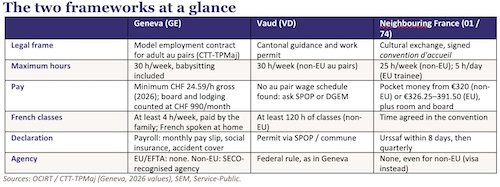
The difference shows up in the budget. At 25 hours a week, Geneva's minimum wage comes to about CHF 2,660 gross a month, of which CHF 990 is board and lodging, leaving about CHF 1,670 in cash, before employer social contributions and half of the health-insurance premium. In France the logic is different: a modest allowance of €320 to €391.50 plus about €260 of flat-rate contributions. Neither is better in the abstract; they are two different designs, and it pays to know which one applies before you advertise.
For other European destinations, AuPair Connect's au pair pocket money reference explains how each country's figures are sourced. For Geneva, the cantonal contract above is the more specific text.
A typical week, on either side of the border
Say you work in Geneva and your children are in primary school. Vaud keeps Wednesday afternoons free of lessons and Geneva primary pupils have school on Wednesday mornings only, so one pattern fits both cantons:

Wednesday afternoon is where the Activities Calendar for kids on knowitall.ch earns its keep: a swimming session, a museum workshop, a library hour, with your au pair meeting new friends along the way. One limit applies on both sides: an au pair does not cover full days, so school holidays still call for day camps or some parental leave.
Before you decide
- Which side? The rules follow the household where the au pair lives, not where you work.
- Which passport? EU/EFTA or not changes the agency and visa steps in Switzerland.
- Which contract? Ask the cantonal authority (OCIRT in Geneva, SPOP or DGEM in Vaud) or your Urssaf before you agree a figure.
This article is general information, not legal advice. The official pages linked above are the place to confirm current figures.
Hosting an Au Pair in the Lake Geneva Basin: Switzerland (GE/VD) vs neighboring France (01/74) at a glance:
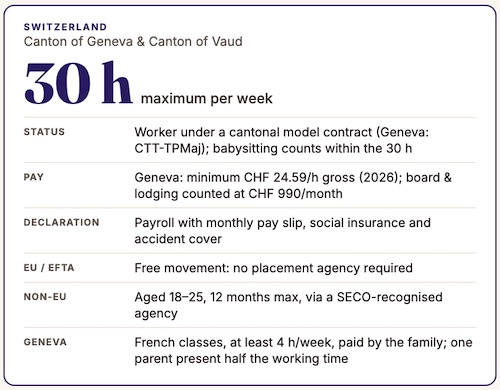
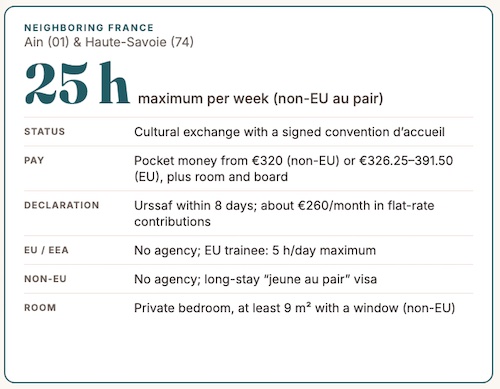
A Wednesday-centered week that fits both sides:

Infographics above: AuPair Connect Research, CC BY 4.0.
Figures as of November 2026 · general information, not legal advice
Practical box · Where to confirm the rules
Geneva: official model contract for au pairs (CTT-TPMaj)
Switzerland: State Secretariat for Migration, au pair FAQ
France: Service-Public, au pair and "stagiaire aide familial"
Local life: Know-it-all passport® calendars and articles
This article was prepared by the team at AuPair Connect, a European platform where host families and au pairs find each other directly. We publish open, sourced guides to au pair rules by country.