



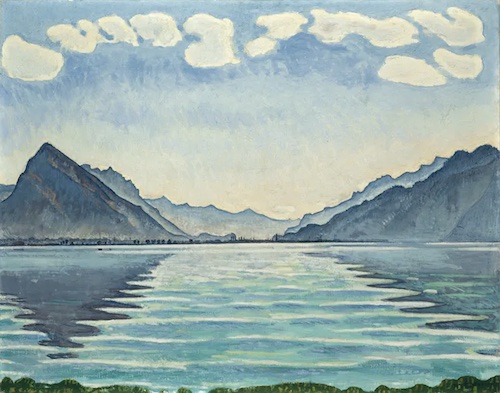
by Kate Lanxner, The HeARTful Blog
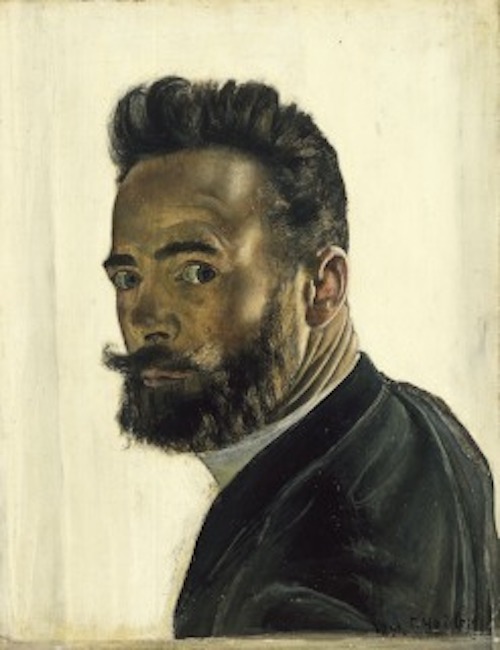
He also painted several self-portraits. The painting above is from 1891 when he was 38 years old. It is also at the museum.
Before he was widely well-known in Switzerland, he went through a figurative phase in allegory painting. He was considered a “symbolist,” painting several murals and panels in public places.
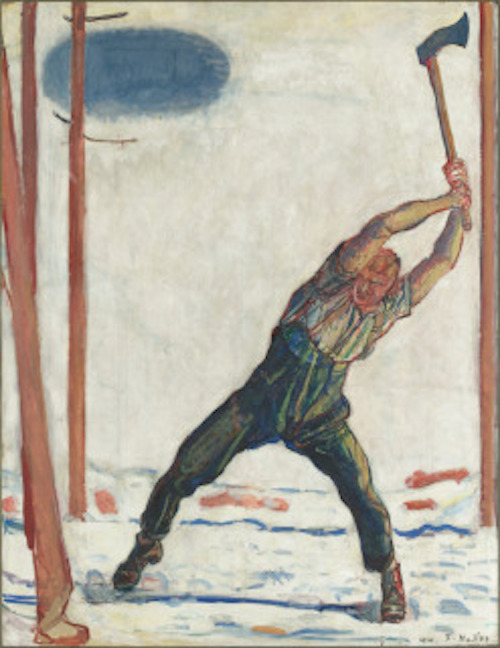
He was also commissioned to illustrate two official Swiss bank notes in 1911, ”The Reaper” and “The Woodcutter,” validating the benefits of good honest work in the countryside.
Overlighting this work was “Parallelism”, a term he coined to represent the connection of humans to nature, by depicting scenes and figures with repetition and symmetry. This can clearly be seen later in his landscapes, including the Thun canvas shown above. He believed it was the job of the artist to show this kind of harmony to the world.
Hodler was a man of convictions, not just for his art, but against destruction caused by war. During WWI, he was outspoken about the bombing of the Reims Cathedral in France by the Germans. The whole roof was destroyed. As a result, Germany stopped exhibiting his paintings, and he lost some valuable clientele. This may be part of the reason his work was not recognized in that time period in America, as much as the French impressionists’. But there have been retrospectives - In New York City, as well as in Paris at the Musée d’Orsay in recent years.
Musée d’Art et d’Histoire - MAH
Rue Charles-Galland 2
1206 Genève
022 418 26 00
mah@geneve.ch
Open Tuesday through Sunday from 10h-18h, Thursdays till 21h.
Free entry to the temporary exhibitions on the first Sunday of each month.
Author's bio
 Kate Lanxner
An American and former Geneva resident, an art teacher for more than 25 years, and a published illustrator. She currently teaches in Montgomery County, Maryland, outside of Washington D.C. in the U.S.
After graduating from art school, she traveled to Paris and took part in a printmaking program at Atelier Contrepoint (formerly Atelier 17) in color etching and engraving, directed by the late Stanley William Hayter. She has not only taken to making art, but sharing her knowledge through The HeARTful Blog.