






By Salvador Jovells, clino.ch
The day your cleaner, nanny or babysitter starts, you become an employer, from the very first franc, even for two hours a week. That means social contributions (AVS), accident insurance and a payslip. In Geneva and Vaud there are three ways to handle it.
1. Geneva: Chèque service
Geneva is the only canton with its own scheme, run since 2008 by the non-profit foundation PRO. You report the hours; they calculate the contributions, collect them from you and pay them to the right funds. The fee is 5.98% of the gross wage below 8 hours a week and 5.48% from 8 hours, capped at CHF 2,200 per year and contract. Everything happens in French.
2. Vaud: Chèques-emploi
In Vaud, the association EPER runs Chèques-emploi. It works the same way, for a fee of 5% of the gross wage, capped at CHF 70 a month (CHF 98 above the pension-fund threshold). It covers Vaud only and does not find staff for you.
3. Clino: your own contract, in English clino.ch
You can also employ directly: register with the cantonal compensation fund, take out accident insurance and do the monthly payslips. That is where most families get lost, and it is why we built Clino. It prepares the employment contract, the registration, the accident insurance and every payslip, in English, for a flat CHF 19.90 a month in all 26 cantons. You stay in control: you sign, and you pay the contributions straight to the fund.
Speed Meeting du Bénévolat
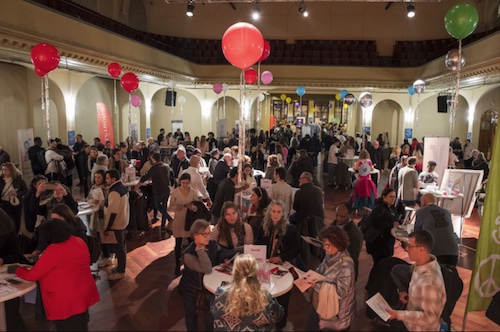
Meet more than 50 organizations active in fields as varied as culture, sports, social action, the environment, health, and education. You’ll have the opportunity to meet organizations (non-profits, foundations, municipalities) of all sizes.
One place, dozens of opportunities
Each organization will have 7 minutes to introduce itself to you and inspire you to join the adventure!
You can meet as many organizations as you’d like, at your own pace, based on what interests you at the moment.
Program and Information
17h30: Doors open
17h40: Introduction
18h00: 1st round of Speed Meeting
19h00: Break
19h15: 2nd round of Speed Meeting
20h15: Closing remarks
20h30: Apéritif

When Marian Crole contacted us about her French-language audio meditation, we definitely wanted to learn more. She kindly shared the following with us.
Why did you start?
For years, I balanced two parallel careers: as a Human Resources Crisis Management consultant for the State of Geneva, and as an artist and musician. During a concert, I had a sudden realisation: art is a much more direct way to connect with people.
This spark motivated me to leave my position to focus entirely on art. Yet, even though I thought I was done with coaching, people started approaching me for support. Some needed help with creative projects, while others requested training or executive coaching mandates. This reminded me of two things: first, that human development is my true passion; and second, that as a freelancer, I could finally merge my two worlds. On one side, a formal structured approach with technical tools from the institutional field; on the other, my artistic approach and creative tools.
I saw that this unique blend worked immediately for my clients, so I naturally continued. I no longer have to choose between the rigour of a crisis manager and the fluidity of an artist; I offer a multidimensional approach based on body and soul.
Have you been working on this idea forever?
It is the logical culmination of a thread I have been weaving since my early twenties. My foundation is in designing learning programmes and human resources; I have always worked on projects bridging different populations, often in the field of sustainable development. Coaching arrived gradually, alongside my work as a trainer and ombudswoman. Today, I am celebrating ten years of practice as an independent coach.
So, it’s not a new idea, but simply the natural evolution of what I’ve always done: connecting people with each other and with themselves. Before, I worked within large organisations; now, I do it in total freedom, with complete flexibility for every context. It’s a continuation, not a career change.


CVCI press release, 12.2025
Addressing the shortage of skilled labor has become a major challenge for the Vaud economy. In response to this issue, the Vaud Chamber of Commerce and Industry (CVCI) and the State of Vaud, through the Department for Economic Promotion and Innovation (SPEI), are launching Vaud Talent Hub—a joint platform dedicated to welcoming, integrating, and retaining talent. This initiative is part of the cantonal action plan “Labor Shortage, Employability, Integration 2025–2027,” adopted by the Council of State, and is one of 16 measures set out in the plan.
Lausanne, December 5, 2025 – Switzerland is expected to face a shortfall of 431,000 workers by 2040, according to economiesuisse. In the canton of Vaud alone, 50,000 full-time positions could remain vacant within the next decade. In this context, attracting and retaining talent—whether graduates from higher education institutions, qualified professionals, international talent, or Swiss citizens living abroad—has become a key factor for competitiveness. To address this challenge, CVCI and the State of Vaud have jointly developed Vaud Talent Hub, a bilingual platform designed for individuals wishing to settle, work, and build their careers in the canton.
- TradeSplaining, an anti-conference podcast about the Geneva expat bubble and beyond
- Why I look forward to Volkmar Völzke's newsletters at noon on Friday
- Launch of the British-Swiss Chamber of Commerce Lausanne Chapter
- Win a 6-week coaching session at Finding Your Happy!
- New book published: The International Career Couple Handbook
- How to Get Out of Your Own Way, a first publication by Sunita Sehmi
- New crowdfunding project celebrates diversity in Geneva!
- Is your business GDPR-ready for the new data protection laws coming in May 2018?
- Meet the women who work in digital at a local MeetUp near you!
- Boost your professional performance with a series of one-day high-impact courses by NotchUP Training
Page 1 of 7

Latest news


- 1
- 2
- 3
- 4
- 5
- 6
- 7
- 8