


 Sabine Hutcheson is an education professional with over twenty-five years’ experience in teaching and leadership in schools in Switzerland, the UK and neighbouring France. Sabine has worked as a Teacher, Education Consultant, University and Careers Advisor and, in the past eight years, has held senior leadership positions in schools in Geneva. She is currently the Head of Secondary Admissions at Geneva English School.

By Sabine Hutcheson, Director of Marketing & Head of Secondary Admissions at Geneva English School
Why does Drama play an important role in children’s education?
Amongst the creative arts that are taught in most schools, namely Music, Art & Design, and Drama, the latter often doesn’t feature formally on the curriculum or, more often, is undervalued and amalgamated with language learning. Drama is, however, a key discipline through which children develop personally and emotionally and hone the skills that will serve them throughout their lives as successful members of their community.
How does Drama fit in a school's curriculum?
Drama is often overlooked in schools, as reflected, for example, in its complete absence from the Swiss curriculum. Exceptions are found, however, in schools such as Ecole Rudolph Steiner, which includes theatre and circus acts in its programme. Placing Drama at the heart of learning is a pedagogical choice to link personal development with academic progress. Schools offering the English National Curriculum, as Geneva English School, make a deliberate effort to afford the same consideration to Drama as to the other creative arts. From the Early Years Programme all the way to Secondary school, children are taught by a specialist teacher, in a bespoke drama studio. From storytelling to interpreting characters, to using body language to convey emotions, to verbally articulating complex ideas, skills explored in Drama are essential for the personal growth of young people.
Drama as a tool for personal development
Drama is an invaluable tool for developing confidence, communication skills, and effective social and professional interaction. It acts as practice for life itself - teaching how to conduct oneself successfully, understand emotions, and interact more constructively with others. It links perfectly to the study of language, syntax, tone and vocabulary.
In the Geneva region, in addition to choosing a school that delivers Drama as part of its curriculum, international families have the opportunity to enrol their children in English-speaking theatre groups that offer structured and wide-ranging programmes, such as Simply Theatre. Beyond traditional theatrical performance, children and teenagers have access to LAMDA examinations in acting and musical theatre. The former, training for which can also be held within schools such as GES, covers Speaking Verse and Prose, Reading for Performance, and Speaking in Public. In doing so, young people learn to communicate clearly, concisely and persuasively, and also build their confidence and self-esteem.
By Sabine Hutcheson, Director of Marketing & Head of Secondary Admissions at Geneva English School
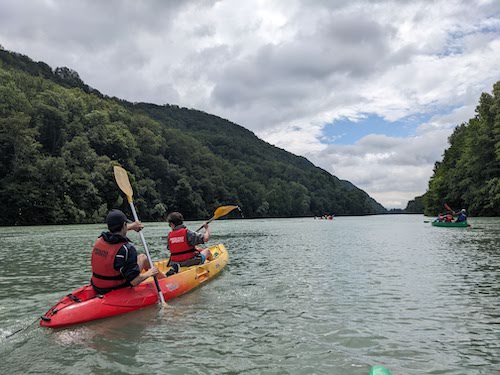
What is Outdoor Education?
The term Outdoor Education encompasses a broad range of activities, topics and skills. From learning about nature, to planning and taking part in an expedition in the mountains, it is an opportunity to get young people away from their phones and laptops and out into the great outdoors.
How does it fit into a school's curriculum?
For decades in the UK, teachers have been trained to deliver the Duke of Edinburgh Award in Secondary schools. The programme consists of a series of challenges that lead to three levels of certification for young people between the ages of 14 and 18: Bronze, Silver and Gold. Challenges range from setting up camp to planning and leading expeditions, increasing in duration and difficulty.
Local schools such as Geneva English School offer a broader range of opportunities leading to the Duke of Edinburgh Award to ensure students of all ages, starting with Early Years and Primary, experience life outdoors and develop essential life skills, including problem-solving, working as a team, resilience and managing stressful situations. Physical activity outdoors helps the mind focus on the here and now, which ultimately contributes to greater focus and discipline both in and out of school.

Photo by Mimi Thian on Unsplash
By Sabine Hutcheson
In the wake of travel restrictions and uncertainty linked to a now two-year long pandemic, international families settled in the Geneva area may have come to question how far they are willing to send their children to university. Amongst the expat community and the international schools of Geneva, Switzerland did not feature high as a choice for university destination compared to the UK and North America. However, Swiss universities have become an increasingly attractive prospect.
With 7 of the 12 Swiss public universities ranking in the world top 100, the case for an academic choice with real prospects of employment is obvious. Moreover, the mere CHF 1000.- annual fee makes one wonder about the post-Brexit cost of UK universities, especially for institutions that do not even make the top 200. Fees for EU/CH residents, which used to be around £9,000 annually now range from £15,000 to £40,000. Yet there hasn’t been a significant surge in applications at local public universities. So what’s the catch?
Language can clearly be a barrier. Anglophone students who have not had the chance to learn French will struggle to reach the required B2 level for entry at university. Language learning and integration is, therefore, something to factor in for newly arrived families, as early as possible in a child’s life. Public schools in Geneva and Vaud present a complex structure of a variety of academic levels which can seem daunting but once in the system, there are many possible routes towards higher education, including via vocational training. For students who arrived in the area in their teens, an emerging number of courses are available in English, such as the Bachelor’s in Economics and Management at the University of Geneva or the Bachelor’s in International Business at the Haute Ecole de Gestion. The International University in Geneva offers many English-speaking possibilities.

By Sabine Hutcheson, Head of Sixth Form, British School of Geneva
In a region where we are spoilt for choice in post-secondary education, A-Levels stand out as the true alternative. Recognised as a ticket to universities internationally, the A-Levels programme is very different to other diplomas in its structure and in the way it prepares students for higher education.
Structure and ethos of the diploma
Students taking A-Levels are typically 16 to 18 years of age and the programme is two years long. In the UK, this stage of education is referred to as the Sixth Form. It immediately follows the General Certificate of Secondary Education (GCSE) in the UK, obtained at the age of 16 and marking the end of compulsory education.
In the first year (Year 12), students study 4 subjects for which they are examined in May and June of that academic year. In their second and final year (Year 13), students tend to drop a subject and pursue the 3 with which they feel most comfortable and/or which better fit their chosen university course admission criteria. Some students choose to maintain all 4 subjects to add to the challenge or to keep their options open. A subject taken in Year 12 only will be validated as an AS Level (Advanced Subsidiary Level) and may count towards university applications.
By Sabine Hutcheson, Head of Sixth Form, British School of Geneva
In a region where we are spoilt for choice in post-secondary education, A-Levels stand out as the true alternative. Recognised as a ticket to universities internationally, the A-Levels programme is very different to other diplomas in its structure and in the way it prepares students for higher education.
Structure and ethos of the diploma
Students taking A-Levels are typically 16 to 18 years of age and the programme is two years long. In the UK, this stage of education is referred to as the Sixth Form. It immediately follows the General Certificate of Secondary Education (GCSE) in the UK, obtained at the age of 16 and marking the end of compulsory education.
In the first year (Year 12), students study 4 subjects for which they are examined in May and June of that academic year. In their second and final year (Year 13), students tend to drop a subject and pursue the 3 with which they feel most comfortable and/or which better fit their chosen university course admission criteria. Some students choose to maintain all 4 subjects to add to the challenge or to keep their options open. A subject taken in Year 12 only will be validated as an AS Level (Advanced Subsidiary Level) and may count towards university applications.
Page 1 of 2